
North Carolina sees opportunity in Opportunity Zones
Last week, Manning, Fulton & Skinner, P.A. hosted its 9th “Executive Speaker Series” in Raleigh to discuss the new regulations for Opportunity Zones, published in April of 2019.
As part of the 2017 “Tax Cuts and Jobs Act”, Congress established a new initiative to incentivize development and growth in historically distressed areas. These areas, called “Opportunity Zones” were defined by state and local governments last year.
North Carolina’s Department of Commerce established 252 zones across the state and were selected largely based on census data. Low-income census tracks have been defined as areas where the poverty rate is 20 percent or greater and/or family income is less than 80% of the area’s median income.
The law provided three key incentives for investors in an Opportunity Zone:
- A temporary deferral of taxes on capital gains reinvested.
- A permanent deferral of taxes on capital gains reinvested up to 15%.
- A permanent exclusion from taxable income of future appreciation.
The incentives are designed to reward long-term investments—as shown below in Figure 1.
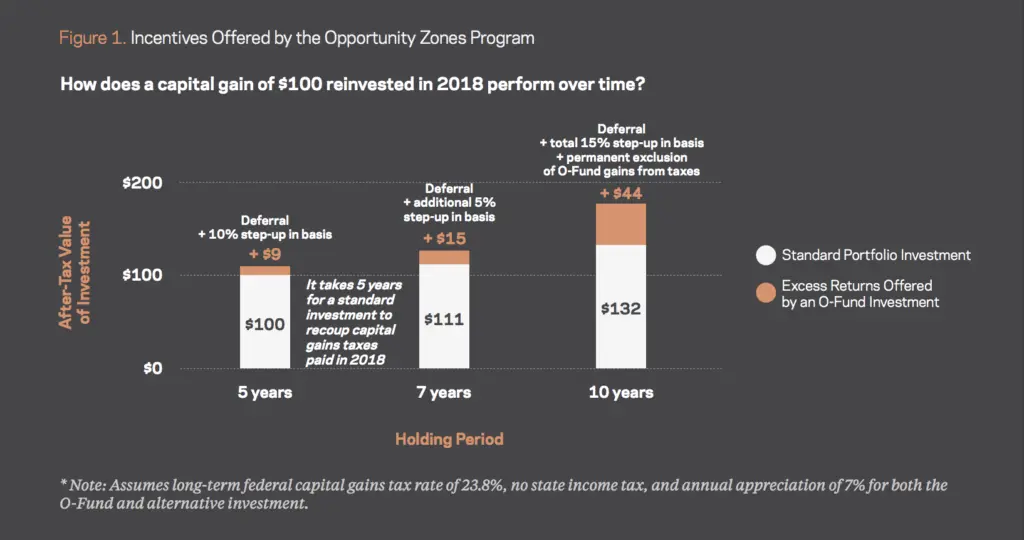
Source: Economic Innovation Group Fact Sheet.
The opportunities seem to be endless.
Bradley Wooldridge, an attorney in the Corporate practice group who has been dealing with Opportunity Zone regulations since the law’s passage in 2017, highlighted the potential benefits, fund options, penalty structures, and compliance components during the presentation.
“Opportunity Zones provide a very attractive benefit if you have the right project,” said Wooldridge. “But, compliance is complicated—particularly with new and still fluid guidance and with some unanswered questions still remaining.”
So, who qualifies to make these investments?
- Opportunity Zone investments must be made through an Opportunity Zone Fund. In order to qualify, the fund must be organized as corporation or a partnership for the purpose of investing in a Qualified Opportunity Zone Property. The Fund must also pass a 90% asset test—meaning 90% or more of the Fund’s property must be invested in the qualified Opportunity Zone.
- The new regulations clarify and provide much needed guidance on what qualifies as a Qualified Opportunity Zone Property.
The reality is there is still much to be ironed out, but the Opportunity Zones are open for business. A full list of North Carolina’s Opportunity Zones can be downloaded here.
Interested in pursuing a deal in an Opportunity Zone? Let’s talk.
Additional Resources:
Related Professionals
-
Kevin A. Prakke
Attorney